
Evaluate the cuff, posture, pause and series rule; Do not automatically select the lowest or highest value.
A practical approach
Comparability is more important than excessive frequency. The same posture, the same time and careful recording of conditions help to distinguish a stable trend from a random fluctuation.
The pressure and conditions of the procedure change, and successive measurements themselves affect the person’s condition, so a difference does not always mean a breakdown. First practical guide for this task: stop and restore the same calm posture.
Four consecutive steps
- 01
Stop and restore the same calm posture.
- 02
Check the position of the cuff and arm.
- 03
Follow the interval from the instructions.
- 04
Record the series according to the rule recommended by your doctor.
What most often distorts observation?
- Do ten repetitions in a row.
- Reposition the cuff between each measurement.
- Taking the average of any numbers is universally correct.
How does this relate to Vesometr
Vesometr allows you to maintain a consistent total and describe the series, but does not determine which value is clinically significant.
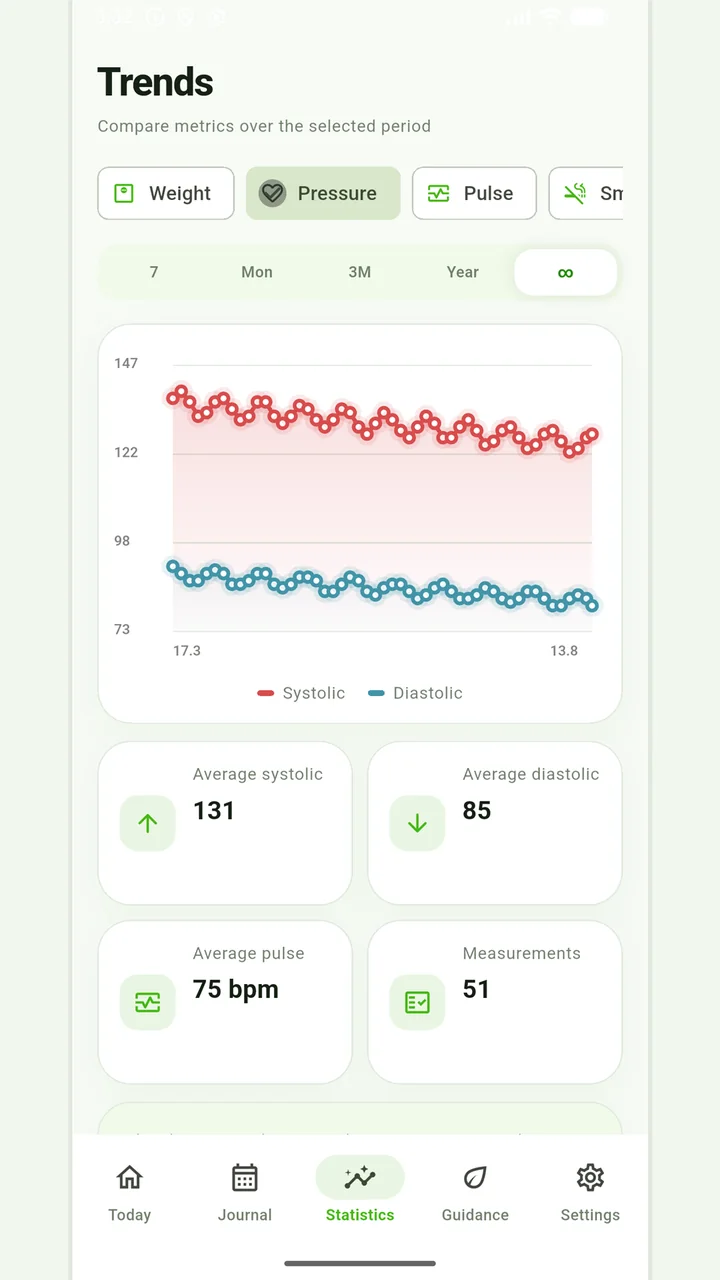
Blood pressure and pulse
Measurements, wellbeing and the circumstances of each reading in one entry.
How to use the collected data
Home measurement is only useful if the procedure is clear: a few minutes of rest, a suitable cuff, support for the back and arms, no talking while the tonometer is working.
For a final review, go back to the last step: record the series according to the rule recommended by your doctor. Compare it to the original target and specifically note exceptions that cannot be explained by the available records.
Vesometr does not assess the risk of indications and does not prescribe treatment. If there is a sharp deterioration in health, chest pain, severe shortness of breath, speech impairment, weakness in a limb or other acute symptom, urgent medical attention is needed, and not an entry in the application.
Full medical disclaimerBrief conclusion
The pressure and conditions of the procedure change, and successive measurements themselves affect the person’s condition, so a difference does not always mean a breakdown. Working minimum to continue: stop and restore the same calm posture. After this, use the remaining points as a testable plan and keep only actual observations.