
Select two or three fields and do not mix hours data with a personal assessment without clearly identifying the source.
Preparation
The coincidence of two events in time does not mean that one caused the other. The diary helps to see repeatability and prepare a hypothesis, but does not replace diagnostics.
For most everyday observations, sleep time, subjective quality, and unusual awakenings are sufficient, rather than complex phase tracking. First practical guide for this task: write down your approximate bedtime and wake-up time.
Step-by-step checklist
- 01
Write down your approximate bedtime and wake-up time.
- 02
Add a personal quality rating on one scale.
- 03
Celebrate a change in routine, illness, or trip.
- 04
Compare weeks, not just one night.
What most often distorts observation?
- Consider wearable device data as medical research.
- Fill in the exact time by guess.
- Attribute any symptom to lack of sleep.
How does this relate to Vesometr
In Vesometr, it is convenient to record your sleep in a diary note next to your weight, blood pressure and general well-being.
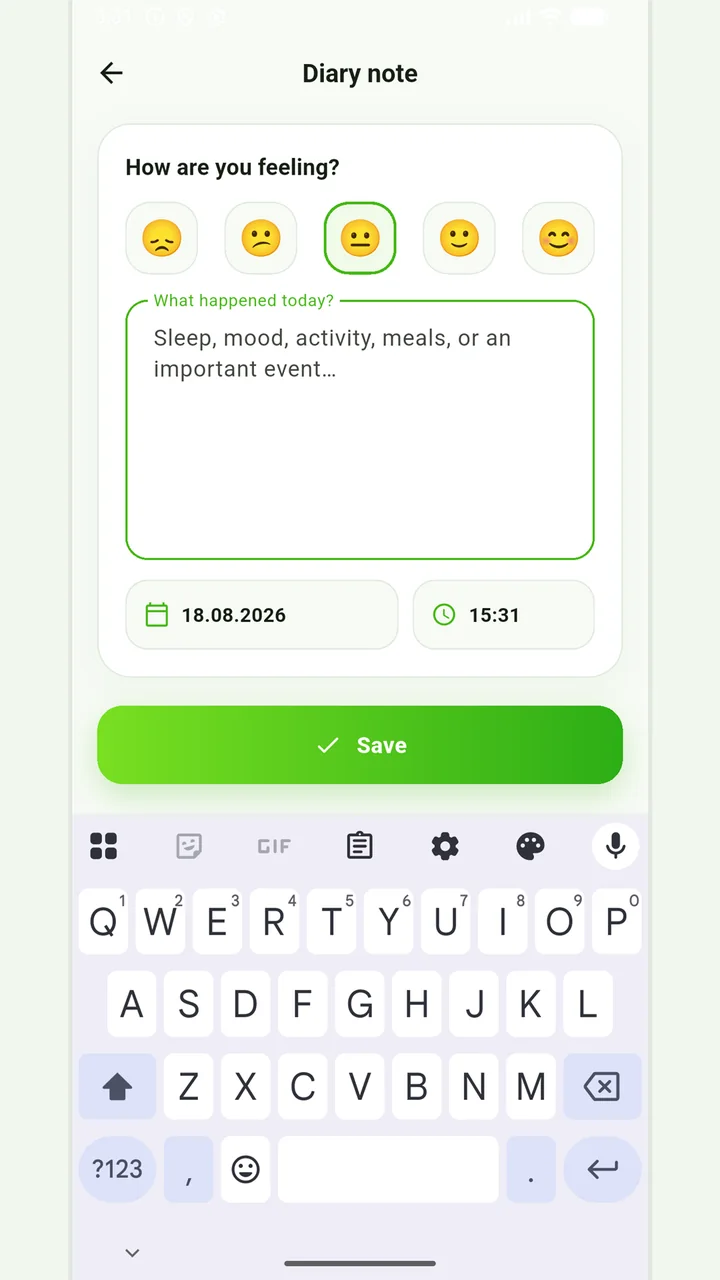
Wellbeing and notes
Mood, a personal rating and free-text context for the selected day.
A calm review of the records
A short daily note works better than a long report that is difficult to maintain. A scale, one observation and an important event of the day are enough.
For a final review, go back to the last step: compare weeks, not just one night. Compare it to the original target and specifically note exceptions that cannot be explained by the available records.
The article and appendix do not determine the cause of symptoms. If your illness is severe, unusual, or worsening, seek medical attention regardless of your diary entries.
Full medical disclaimerBrief conclusion
For most everyday observations, sleep time, subjective quality, and unusual awakenings are sufficient, rather than complex phase tracking. Working minimum to continue: write down your approximate bedtime and wake-up time. After this, use the remaining points as a testable plan and keep only actual observations.